
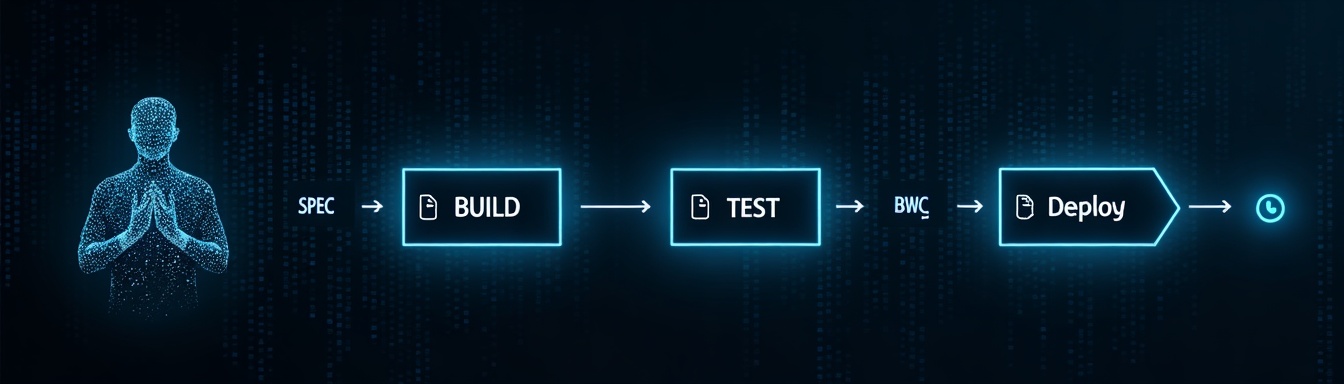
The most valuable engineer on your team in 2026 might not write a single line of production code. That's not a dystopian prediction. It's a hiring strategy. LG CNS and Cline's Spec Driven for Enterprise is the clearest signal yet that agentic AI has moved from autocomplete assistant to autonomous SDLC participant. Under this model, a team of specialized AI agents handles requirements analysis, system design, code generation, bug-fixing, test creation, and quality verification — against your own codebase, your own knowledge assets, your own compliance constraints. Human engineers review outputs and make quality decisions. The AI ships the implementation. If your hiring plan still optimizes for "engineers who write great code fast," you're already optimizing for the wrong thing.
What Spec Driven Actually Does (And Why It Matters)
Most AI coding coverage focuses on copilots: tools that help engineers write code faster. Spec Driven is a different category entirely. The LG CNS deployment integrates Cline's open-source coding agent with LG CNS's internal DevOn AI Native Development platform and a proprietary "Knowledge Foundation" database that encodes decades of LG CNS project expertise. The system uses this substrate to select appropriate technologies, design system architecture, generate code, and automatically create and verify hundreds of test cases — including complex scenarios like financial fraud-detection systems.
This is not a productivity multiplier for your existing engineering workflow. It's a replacement for large portions of that workflow. The distinction matters for hiring. When AI can autonomously execute from natural-language requirements through verified, tested code, the leverage points for human engineers shift entirely upstream and downstream: into the quality of the specification that constrains the AI, and into the verification framework that judges its output. The implementation layer, historically where most engineering headcount lived, becomes the part you staff most lightly. LG CNS plans to deploy this internally first, then expand to external customers. Large-scale enterprise adoption is the trajectory, not a distant experiment.
The New SDLC Topology
Think of the modern AI-augmented engineering org as three distinct pods, not a traditional feature team pyramid.
Pod 1: Spec and Architecture (Small, Senior, Expensive)
This is your highest-leverage group. Staff/principal engineers and senior PMs who translate business requirements into precise, machine-actionable specifications. In a spec-driven AI workflow, the specification is literally the code: vague specs produce broken outputs, rigorous specs produce working systems. The skills you're looking for here are not typical senior engineering skills. You want engineers who have done deep requirements engineering, who understand formal system modeling, who can write specifications that leave no ambiguous surface area for an AI agent to misinterpret. Domain expertise matters enormously here. A principal engineer who deeply understands financial compliance, healthcare workflows, or logistics systems will produce specs that AI agents can execute correctly. A generalist who writes clean Python cannot. Compensation benchmark: Staff/principal engineers with strong requirements engineering and domain expertise are commanding $280,000 to $360,000 total comp at well-funded companies in 2026, roughly 20-30% above equivalent engineers who are primarily implementation-focused. The market is pricing the shift.
Pod 2: Verification and Quality (Growing Fast)
This pod is arguably the most underhired function in engineering right now. As AI agents generate hundreds of test cases and verify their own outputs, someone has to design the test oracles: the formal definitions of what "correct" actually means that the AI is checking against. This requires a different skillset than traditional QA. You're looking for engineers who understand property-based testing, formal verification methods, adversarial test design, and statistical evaluation of model outputs. They're building the frameworks that judge AI-generated code, not writing test scripts for human-written functions. There's a meaningful difference. This pod also handles AI output adjudication: the governance layer that decides when AI-generated code is safe to ship, when it requires human review, and when it needs to be rejected. Think of this as your risk management function for autonomous development. At Spec Driven scale, getting this wrong doesn't mean a flaky test; it means shipping a broken fraud-detection system to production. Compensation benchmark: Engineers specializing in AI evaluation frameworks and test oracle design are emerging as a distinct market segment. Expect to pay $220,000 to $290,000 total comp for strong practitioners, a category that barely existed as a defined role two years ago.
Pod 3: Edge Cases and Integration (Lean, Targeted)
AI agents are excellent at well-scoped, well-specified, well-tested implementation work. They are still unreliable at complex system integrations with poorly documented external APIs, safety-critical paths where failure modes are novel, and legacy codebase archaeology where institutional context lives in engineers' heads rather than in documentation. This pod handles exactly those problems. It's not large. A team that previously needed 15 implementation engineers might need 3-4 here, focused on the genuinely hard integration and safety work that agents cannot yet reliably execute. These engineers also serve as the feedback loop into Pod 1, flagging where specifications need to be more precise based on where agents consistently fail.
Enterprise Knowledge as Infrastructure
Here's the strategic insight that most engineering leaders are missing: in a spec-driven AI workflow, organizational knowledge is infrastructure, not tribal memory. The LG CNS Knowledge Foundation isn't a nice-to-have. It's what makes the agents competent rather than generic. Without encoded project know-how, domain models, and compliance constraints, an AI coding agent produces generic outputs against a generic understanding of the problem. With a rich, curated knowledge foundation, it produces outputs shaped by every prior project, every architectural decision, every regulatory constraint your organization has navigated. This means AI platform engineering is now a core engineering function, not a DevOps side project. Someone has to own the prompts, the evaluation frameworks, the knowledge graph curation, and the governance policies that make your agents better than a competitor's agents. This is durable competitive advantage: it compounds over time as your knowledge foundation deepens, and it's genuinely hard to replicate quickly. Add an AI Platform Engineer role to your org chart if you haven't already. Compensation is running $260,000 to $320,000 total comp for strong practitioners who combine ML infrastructure knowledge with enterprise software engineering depth.
What This Means for Hiring Right Now
The traditional hiring filter: "Can this engineer write clean, performant code in our primary language?" is now table stakes at best, irrelevant at worst for senior roles. Here's how the evaluation framework needs to shift.
| Skill | Traditional Weight | AI-Native Weight |
|---|---|---|
| Implementation speed and code quality | High | Low to medium |
| Requirements engineering and spec writing | Low | High |
| System architecture and domain modeling | Medium | Very high |
| Test oracle design and formal verification | Low | High |
| AI output evaluation and governance | None | Critical |
| Legacy integration and edge case debugging | Medium | Medium to high |
For senior engineering roles above L5, your interview process should include a spec-writing exercise, not just a coding exercise. Give candidates a natural-language description of a business problem and ask them to produce a specification precise enough for an AI agent to implement correctly. Grade on ambiguity elimination, edge case coverage, and constraint articulation. This is harder than LeetCode and far more predictive of performance in an agentic engineering environment. Specific evaluation questions for senior hires:
"Walk me through how you'd structure a knowledge foundation for an AI agent working in [your domain]. What needs to be explicitly encoded, and what can the agent infer?"
"Describe a specification you've written that was misimplemented. What was ambiguous, and how would you fix it?"
"How do you design test oracles for AI-generated code in systems where you can't enumerate all valid outputs?"
These questions will blank-slate most candidates who are strong traditional engineers but haven't yet adapted to working with autonomous AI systems. That gap is your hiring opportunity.
The Competitive Landscape for Talent
Traditional hiring platforms are surfacing candidates filtered on GitHub commit history, LeetCode scores, and years of experience with specific frameworks. These signals are decaying fast. An engineer with 8 years of React experience and mediocre spec-writing skills is less valuable to an agentic team than an engineer with 4 years of experience, deep domain knowledge, and the ability to write machine-actionable requirements. The engineers who will define your team's leverage in an agentic SDLC are not the ones who appear at the top of keyword-matched search results on legacy platforms. They're the ones who have been operating at the specification and verification layer: technical leads who've worked closely with product and architecture, engineers who've done formal verification or model-based testing, domain experts who've built internal knowledge systems. Finding them requires evaluating for the right signals, not filtering on the old ones.
The Team Size Question
One clarification worth being direct about: individual feature teams will get smaller. The team that once needed 12 engineers to ship a new product line might now need 4 to 6, with AI agents handling the implementation layer. That's real, and leaders should plan for it. But this does not mean engineering organizations shrink. The companies winning in 2026 are using the productivity multiplier to attack more problems simultaneously. The same company that consolidates a 12-person team to 6 is spinning up three new product lines that wouldn't have been economically viable before. Your engineering org's footprint grows; individual team sizes contract. The model is elite special operations units: small, high-leverage, AI-augmented, deployed across more missions. The implication for hiring: you need fewer engineers total per project, but the quality bar for each hire rises sharply, and you hire more frequently as you expand the surface area of what you're building. Hiring the right engineers gets harder, not easier, even as team sizes fall.
Where This Goes
LG CNS and Cline are not the only players moving in this direction. The broader tooling trend toward spec-centric, multi-agent enterprise workflows is accelerating across the industry. As more enterprise RFPs begin explicitly requesting "AI-accelerated engineering" capabilities, the teams that have already restructured around spec and verification will have a structural advantage in both delivery speed and talent acquisition. The specification is the new source of truth. The knowledge foundation is the new codebase. The engineers who understand this and can operate at that level are the ones worth competing for. Start evaluating for those skills now, before your competitors figure out the same thing.
Want to supercharge your dev team with vetted AI talent?
Join founders using Nextdev's AI vetting to build stronger teams, deliver faster, and stay ahead of the competition.
Read More Blog Posts
Agentic Coding Tools Are Reshaping Team Structure
The first wave of AI coding tools was a typing upgrade. GitHub Copilot autocompleted your next line, Codex filled in a function body, and the organizational cha
Agentic AI Hits the Enterprise SDLC — Finally
LG CNS and Cline just launched a joint platform that puts autonomous AI agents in charge of the full software development lifecycle, from requirements to produc