
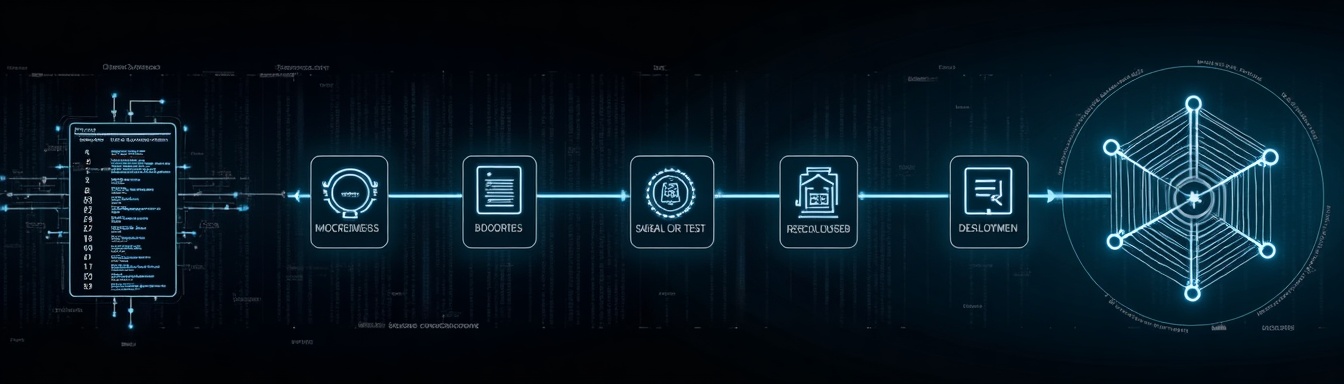
LG CNS and Cline just launched a joint platform that puts autonomous AI agents in charge of the full software development lifecycle, from requirements to production. This is not another code-completion tool. This is the first credible attempt by a major IT services firm to productize end-to-end SDLC automation for the kinds of environments most enterprises actually run: regulated, legacy-heavy, compliance-sensitive systems in finance, government, and defense. If you're still thinking about AI in software development as "GitHub Copilot in my IDE," you're already behind. The question for engineering leaders today is not whether agentic development is coming. It's whether your org will be ready when it arrives at scale.
What LG CNS and Cline Actually Built
LG CNS launched DevOn Agentic AI Native Development (AIND) in partnership with Cline, a U.S.-based open-source AI coding company whose agent has crossed 4 million installs, 50,000+ GitHub stars, and logged 4,704% growth on GitHub. Cline is not a startup pitching demos. It is one of the fastest-growing AI software projects on the planet. The platform deploys specialized agents across a connected workflow:
- •An analysis and design agent interprets natural-language business requirements and generates system architecture
- •A coding agent produces code that conforms to the enterprise's own development standards
- •Automated testing and quality diagnostics agents run continuously after implementation
The entire system is anchored by a Knowledge Foundation: an ontology-based database that ingests your development standards, security policies, source code, and project documentation, then makes all of it AI-readable. This is the piece that separates AIND from every generic coding tool on the market. Agents do not hallucinate your architecture or invent their own security model. They work from your specifications.
Spec-driven, agentic development lets us treat the entire enterprise system as a living specification that AI agents can understand, refine, and implement end-to-end; this is the key to scaling beyond toy coding demos into real, multi-team, multi-year software systems in production.
— Jeffrey Snover, CEO and Co-founder at Cline
The LG CNS and Cline framing is deliberately pointed: this goes beyond "vibe coding" toward structured, spec-driven development at enterprise scale. That framing is correct, and it matters.
Why This Is Different From the Copilot-Era Tooling
The enterprise AI coding market is saturated with point solutions. You have code generation (GitHub Copilot, Amazon Q Developer), test generation (Diffblue, Qodo), and static analysis (Snyk, SonarQube). Each one bolts on to a different stage of your pipeline and creates its own governance gap. AIND collapses those silos into a single, spec-driven lifecycle. The strategic implications are significant:
| Capability | Point-tool approach | AIND / Cline Spec Driven |
|---|---|---|
| Requirements to code | Manual handoff | Automated agent workflow |
| Standards enforcement | Per-tool, fragmented | Knowledge Foundation, unified |
| Data sovereignty | Cloud-indexed, vendor-dependent | Code never leaves environment |
| Vendor lock-in | High | Bring-your-own inference provider |
| Regulated sector readiness | Partial | Finance, government, defense targets |
The data sovereignty model is worth dwelling on. Cline's architecture is fully open source, code never leaves the customer's environment, there is no external indexing or training on proprietary data, and enterprises can choose their own AI inference providers. For CTOs running systems with PII, defense contracts, or financial data, this is the difference between a tool you can actually deploy and one that stays in a pilot forever.
By automating the building and operation of large-scale IT systems based on AI agents with expert-level capabilities across analysis, design, coding, and quality assurance, we expect to fundamentally change how enterprises approach software development and operations, moving from fragmented, human-driven workflows to an integrated, AI-orchestrated lifecycle.
— Hyunjung An, Executive Director at LG CNS
The Org Design Implication Nobody Is Talking About
Most coverage of this launch will focus on the productivity angle. That's the wrong lens. The deeper shift is structural. Platforms like AIND collapse the traditional boundaries between business analysis, architecture, development, and QA into a single spec-driven workflow. This has immediate consequences for how you organize teams. The siloed BA, dev, and test department model was built around handoffs, because humans needed clear swim lanes to avoid coordination failures. When a set of agents handles implementation, test generation, and standards enforcement continuously, those handoffs become overhead. The orgs that win will reorganize around product outcomes, embedding agents into cross-functional squads rather than preserving functional departments that each bolt on their own narrow tools.
This is what Nextdev's thesis looks like in practice. Individual teams get smaller and more senior. The architect, the tech lead, the domain expert: these roles grow in value because the leverage they create is now multiplied across an entire agentic pipeline. A single senior architect whose decisions feed into the Knowledge Foundation is effectively setting the course for every line of code the agents generate. That is an enormous force multiplier, and it means hiring the wrong architect is now a much more expensive mistake than it used to be.
The broader engineering org, though, does not shrink. Companies that figure out agentic SDLC will not respond by cutting headcount to the bone. They will respond by taking on more ambitious projects, more product lines, more markets. LG CNS is already rolling this out across finance, manufacturing, government, and defense, starting in Korea and expanding to the U.S., Japan, and Southeast Asia. That is not a company running fewer engineers. That is a company running more concurrent bets.
What Has to Change in Your Org Before This Pays Off
Here is the part that the marketing materials gloss over. Agentic SDLC platforms are leverage multipliers, not drop-in replacements. They only work well when fed high-quality inputs. If your architecture decisions live in someone's head, if your security policies are inconsistent across teams, if your development standards are a wiki page nobody reads, AIND will industrialize your chaos, not fix it. Before you evaluate any platform in this category, ask:
Can you codify your architecture principles, security policies, and design patterns into a structured, machine-readable knowledge base?
Do you have engineers capable of maintaining that knowledge base and curating it as the system evolves?
Are your requirements processes mature enough that agents will have something coherent to work from?
The third question is the one most orgs fail. Garbage-in, garbage-out is not a new principle, but agentic systems move so fast that garbage propagates into production far more quickly than it did when a human was reading every line of generated code. The investment pattern this implies: reallocate budget away from a constellation of single-purpose tools and toward an integrated platform that can sit inside your environment. Then invest in the AI platform engineer role: someone who maintains the agentic infrastructure, curates the Knowledge Foundation, and owns the feedback loop from production telemetry back into the specification layer. This is a new role that did not exist two years ago and is becoming critical infrastructure.
Competitive Landscape: Who This Threatens
The vendors who should be paying close attention:
GitHub Copilot / Microsoft
Copilot is powerful but lives at the IDE layer. It does not own architecture, testing, or enterprise knowledge management. Microsoft has Copilot Studio and Azure AI Foundry moving in this direction, but AIND is shipping to regulated sectors now.
Atlassian and ServiceNow
Both are adding AI to their workflow tools. Neither has a unified agent architecture that spans requirements to production.
Traditional SI players (Accenture, Infosys, Wipro)
This is the most interesting competitive dynamic. LG CNS is a major systems integrator productizing what was previously professional services. If AIND works at scale, it compresses the labor hours that define the SI business model. Every SI is watching this.
The open architecture and bring-your-own-inference model also means AIND is not locked into OpenAI or Anthropic's continued pricing. That is a hedge most enterprise platforms are not offering.
Your Action Plan for the Next 30 Days
If you are a CTO or VP of Engineering evaluating this space, here is how to move:
Audit your current AI tooling stack. Map every AI tool your teams are using across the SDLC. Count the vendors. Count the governance gaps between them. If you have more than four separate tools covering code generation, testing, analysis, and security, you have a fragmentation problem that an integrated platform directly addresses.
Start building your Knowledge Foundation now, regardless of what platform you choose. The work of codifying architecture principles, security policies, and domain ontologies has value independent of any specific vendor. Teams that complete this work will onboard any agentic platform faster and get better outputs sooner. Start with your most critical service domain and build the structured spec for it.
Identify your first AI platform engineer hire. This is the person who will own agentic infrastructure, curate the knowledge base, and translate production signals back into better specifications. They are not a traditional DevOps engineer and not a traditional ML engineer. They sit at the intersection. Finding someone with that profile on a standard job board is nearly impossible. This is exactly the kind of AI-native talent that requires a different sourcing approach.
The Bottom Line
LG CNS and Cline have shipped the most coherent enterprise agentic SDLC platform to date. The open architecture, data sovereignty model, and Knowledge Foundation approach solve the three problems that have stalled enterprise AI adoption: compliance risk, knowledge fragmentation, and tool sprawl. The orgs that benefit most will not be the ones that simply buy the platform. They will be the ones that pair the platform with genuinely senior engineering judgment at the architecture and requirements layer, and build the internal capability to maintain and evolve the knowledge systems that make agents useful. The competitive advantage in software development is shifting from "how many engineers do you have" to "how well can your engineers feed and direct AI agents." The leaders who internalize that shift, and hire accordingly, will build faster, ship more reliably, and take on more ambitious products than their competitors can match. The window to build that advantage is open now. It will not stay open indefinitely.
Want to supercharge your dev team with vetted AI talent?
Join founders using Nextdev's AI vetting to build stronger teams, deliver faster, and stay ahead of the competition.
Read More Blog Posts
AI Agents Own the SDLC: Hire for Spec, Not Code
The most valuable engineer on your team in 2026 might not write a single line of production code. That's not a dystopian prediction. It's a hiring strategy.
AI Coding Tools in 2026: What the $9B Market Tells You
The number that should stop you mid-scroll: 75% of developers now use AI for at least half of their engineering work. Not experimentation. Not occasional tab-co