
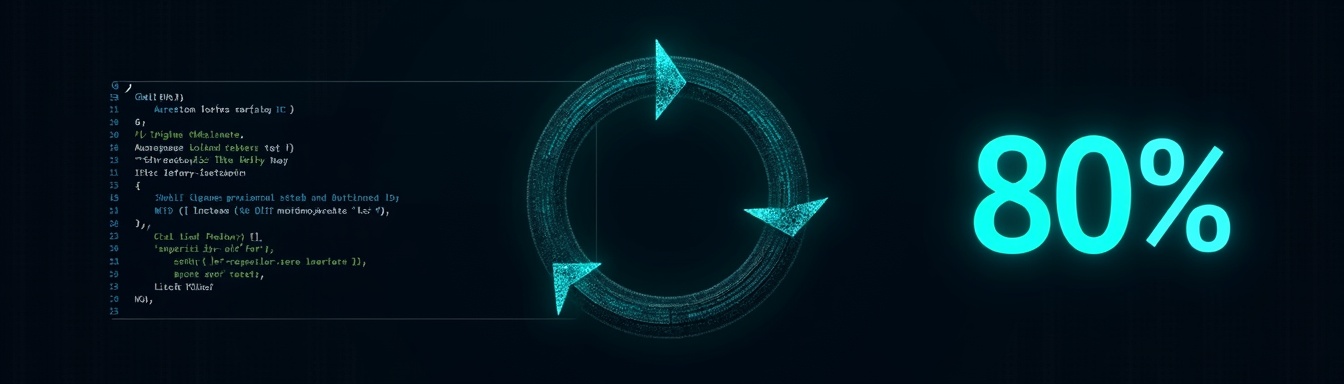
Cursor just shipped something that should reframe how engineering leaders think about automated debugging. Yesterday's Bugbot Learned Rules and MCP Support update introduces real-time self-improvement to Bugbot — meaning the system learns from your team's live code reviews and continuously refines the rules it uses to catch and fix bugs. The result: an 80% bug resolution rate, the highest Bugbot has ever achieved. That's not an incremental improvement. That's a capability shift. For context: most CI/CD automation tools are static. They apply fixed linting rules, pre-baked heuristics, pattern-matched smells. Bugbot just became something different — a debugging system that watches how your engineers actually review code and adapts accordingly. Pair that with new MCP (Model Context Protocol) support and refinements to Bugbot Autofix, and you have a tool that's starting to look less like a code linter and more like a junior engineer that gets smarter every sprint.
What Actually Shipped
The April 8 changelog lays out three distinct capability additions: 1. Learned Rules from Live Code Reviews Bugbot now observes your team's active code review process and extracts patterns — what your senior engineers flag, what gets marked as a blocker versus a nitpick, what the team consistently approves without comment. Those patterns become rules Bugbot applies going forward. This is adaptive AI applied directly to the debugging loop. 2. MCP Support Model Context Protocol integration means Bugbot can now connect to external tools and data sources — think internal documentation, ticketing systems, observability platforms — and use that context when evaluating bugs and generating fixes. A bug that requires understanding a Datadog alert pattern, a Jira issue history, or your internal API spec is now within scope. This is a significant architectural unlock. 3. Autofix Improvements The Autofix feature — which automatically proposes and applies code fixes — has been refined in this update, contributing directly to the near-80% resolution rate milestone. Bugbot isn't just finding more bugs; it's correctly fixing more of them on the first pass.
Why 80% Is a Real Number Worth Acting On
Skepticism is healthy here, so let's be precise about what "resolution rate" means in this context. Bugbot's rate reflects bugs identified in PRs that are resolved without requiring human intervention — either auto-fixed correctly or flagged accurately enough that engineers accepted the resolution immediately.
At 80%, you're automating the majority of routine bug resolution in your review pipeline. For a team handling 50 PRs per week, that's potentially 40 bug cycles that don't land in a human's queue. The back-of-the-napkin productivity math is significant: if each manual bug review costs 30 minutes of senior engineer time, you're recovering 20 hours per week per team. At scale, across a 10-team engineering org, that's 200 hours recaptured weekly — nearly five full-time engineer equivalents redirected toward building.
Software is eating the world, but AI is eating the software development process.
— Satya Nadella, Chairman and CEO at Microsoft
This is exactly the compounding dynamic Nadella is describing. Every point of resolution rate improvement isn't linear — it compounds because freed senior engineers aren't just saving time, they're accelerating the higher-order work that drives product velocity.
The Real Risk Nobody Is Talking About
Here's the honest concern: real-time learning from live code reviews is only as good as the reviews it learns from. If your senior engineers are inconsistent reviewers — and most teams have at least some review quality variance — Bugbot will learn those inconsistencies and codify them as rules. A subtle bias in how one senior engineer reviews authentication code could propagate into a standing rule that deprioritizes a class of security bugs. You'd never see it happening because the automation would look correct on the surface. This is not a reason to avoid adoption. It's a reason to build validation layers alongside adoption. Practically, this means:
- •Audit learned rules quarterly. Cursor should expose the rule library Bugbot builds; demand visibility into what it's learning. If that's not surfaced in the UI yet, it should be on your feature request list.
- •Seed the system with your best reviewers first. Bugbot learns from whoever is doing reviews. If you're piloting this, have your strongest engineers lead the initial review cycles so the learned rules reflect your highest-quality standards.
- •Don't disable human review on security-critical paths. The 80% resolution rate is a portfolio number. Some bug categories warrant 100% human eyes regardless of automation confidence.
Teams that treat Bugbot as a black box will eventually encounter learned rules they didn't intend. Teams that treat it as a collaborator they manage will capture the full upside.
Competitive Landscape: Where Does This Leave Copilot and Claude Code?
Let's put Bugbot's positioning in context against the tools your teams are already evaluating.
| Tool | Primary Strength | Bug Resolution Focus | MCP Support | Self-Learning |
|---|---|---|---|---|
| Cursor Bugbot | AI-native debugging | ~80% resolution rate | ✅ (new) | ✅ (new) |
| GitHub Copilot | Broad IDE integration | Moderate (suggestions-based) | Partial | ❌ |
| Claude Code | Complex reasoning | Strong on nuanced bugs | ✅ | ❌ |
| Codeium | Speed and autocomplete | Limited | ❌ | ❌ |
Bugbot's 80% resolution rate is the headline metric here, and no competitor is publishing an equivalent number. GitHub Copilot's strength remains breadth — IDE integration, PR summaries, code generation — but it's not architected around autonomous bug resolution the way Bugbot is. Claude Code brings serious reasoning depth, particularly on complex or ambiguous bugs, but it doesn't have Bugbot's feedback loop mechanism. The more important competitive dynamic: this update signals that Cursor is racing toward full-stack PR automation, not just code completion. MCP support is the tell. When Bugbot can pull context from your observability stack, your ticket history, your architecture docs — it starts to compete in territory that GitHub Copilot hasn't fully addressed. GitHub's advantage is the native integration with GitHub repositories and Actions. Cursor's counter is deeper AI reasoning applied to the actual code quality loop. Expect GitHub to respond. Anthropic and Google are both investing heavily in agentic coding workflows. But right now, for teams whose primary pain point is debugging throughput and review bottlenecks, Bugbot is ahead.
What Engineering Leaders Should Do This Week
Don't wait for a perfect rollout plan. The teams that win with AI tooling are the ones who run structured pilots fast, measure aggressively, and scale what works. Here's the specific playbook:
Identify a pilot team — pick a team with a high PR volume (15+ PRs/week) and strong review culture. You want enough volume for the learning loop to generate signal quickly, and you want Bugbot learning from good reviewers.
Establish your baseline now — before Bugbot learns anything, capture your current metrics: average bugs per PR, time-to-resolution, review cycle time. You need pre/post data or you're flying blind on ROI.
Integrate MCP with one external system in week one — don't try to connect everything at once. Pick your highest-signal context source — probably your error tracking tool (Sentry, Datadog) or your internal runbooks — and wire that in first. See how Bugbot's fix quality changes when it has context.
Set a 4-week evaluation window — Bugbot's learning loop needs time to accumulate useful patterns. Evaluate resolution rate, false positive rate, and engineer sentiment at the 4-week mark. If you're hitting 70%+ resolution with acceptable false positives, begin scaling.
Audit the learned rules at week four — before you expand the pilot, review what Bugbot learned. Make sure the rules map to your intended standards. Reject or override anything that looks like a captured anti-pattern.
Define your 70% threshold as the scale trigger — if your team is hitting 70% or higher automated resolution in the pilot, that's your signal to expand. Below 70%, troubleshoot before scaling.
The Bigger Picture for Engineering Teams
This update is a useful data point in a larger trend: AI tools are moving from assistive to autonomous in the code quality workflow. Bugbot isn't suggesting fixes — it's resolving bugs, learning from your team, and improving without manual configuration. That's a meaningful architectural leap. For engineering leaders, the implication isn't "we need fewer engineers." It's "our engineers can now operate at a different altitude." The senior engineer who used to spend 30% of their week reviewing routine bugs now has that capacity redirected toward architecture decisions, system design, mentorship, and the genuinely hard problems that automation won't touch for years. The teams that will feel this most acutely are the ones still running traditional review workflows — lots of human cycles on routine catches, slow feedback loops, review bottlenecks blocking sprint velocity. Bugbot's self-learning capability is essentially a force multiplier applied directly to that bottleneck. The question for every engineering leader reading this isn't whether to adopt AI-native debugging tools. That ship has sailed. The question is how fast you can adapt your workflows, your review culture, and your hiring standards to capture the upside before your competitors do. The teams building for 2026 aren't staffing up to do more of the same. They're staffing elite, AI-augmented squads that move faster and cover more ground than twice the headcount could three years ago. Bugbot's 80% resolution rate is one more tool in that arsenal — and it just got meaningfully better. Don't wait to pilot it. The learning loop starts the moment you do.
Want to supercharge your dev team with vetted AI talent?
Join founders using Nextdev's AI vetting to build stronger teams, deliver faster, and stay ahead of the competition.
Read More Blog Posts
AI Tools Weekly: Claude Code 2.1.98 Drops 5 Key Updates
TL;DR: Anthropic shipped three Claude Code releases on April 8, 2026 — 2.1.96 through 2.1.98 — adding an interactive Google Vertex AI setup wizard, fixing a cri
Claude Code 2.1.94: Bedrock Support Changes the Game
Anthropic shipped Claude Code 2.1.94 this week, and the headline feature isn't the UI polish — it's Amazon Bedrock integration via Mantle and a default effort l